

WHY DHIKR MATTERS
Why Dhikr Matters: Building a Morning and Evening Remembrance Routine
A source-aware, practical guide to making room for dhikr in the morning and evening without turning worship into a productivity score.
Dhikr—remembrance of Allah—belongs to worship, not to the logic of a productivity contest. A morning or evening routine can make remembrance easier to return to, but the point is not to collect a longer streak, race through a list, or claim a guaranteed result. The useful question is simpler: how can a Muslim make reliable space for remembrance before the demands of the day or the pull of the screen take over?
01 · PRACTICAL GUIDE
What the cited sources establish—and what they do not
This guide offers a practical structure. It does not issue religious rulings, set prescribed time windows, replace a trusted scholar, or invent any devotional text. You can follow the method with a source-traceable collection and without installing an app.
The two short passages below are presented as source records, not advertising copy. Their wording must not be edited.
“and glorify Him morning and evening.”
The verse places glorification within a morning-and-evening rhythm. It should not be stretched into a claim that one commercial product, one checklist, or one personal schedule is religiously required.
“Keep your tongue moist with the remembrance of Allah.”
This report supports the general importance and continuity of remembrance. It does not name an app, prescribe a particular morning or evening timetable, or promise a worldly outcome. Keeping those boundaries visible protects the sources from being turned into sales claims.
02 · PRACTICAL GUIDE
Why morning and evening can be useful anchors
The beginning and close of the day are easy to recognise. That makes them practical anchors for a repeated action. An anchor is not the same thing as a religious ruling: it is simply a cue in your existing day that helps you remember what you intended to do.
Morning attention can be claimed quickly by notifications, work messages, or an automatic social-media check. Evening attention can disappear into unfinished tasks and one more scroll. A modest routine creates a pause before either pattern becomes the default. The benefit of the structure is not that the clock makes the worship valid; it is that a clear cue reduces the number of decisions needed to begin.
When a verified adhkar collection gives religious guidance about wording, repetition, or timing, follow that source rather than this article. If you are unsure about a religious question, ask a qualified person you trust.
03 · PRACTICAL GUIDE
Build a source-aware routine in six steps
- 1Start with a traceable collection
Choose a collection that identifies where its material comes from and preserves the approved wording. Avoid copying attractive text from an unlabelled graphic, a clipped video, or a page that does not show its sources. This article deliberately does not reproduce an adhkar list; the integrity of the collection matters more than filling a page with devotional text.
- 2Attach the routine to events you already notice
For personal organisation—not as a ruling about prescribed times—choose ordinary cues such as getting ready for the day and beginning your evening wind-down. Keep the cues realistic. A routine that depends on a perfect, quiet hour is easier to abandon than one that fits the life you actually have.
- 3Remove the first layer of friction
Decide in advance where you will access the verified collection. Put it somewhere easy to reach. If your phone is the tool, open the collection before opening feeds or messages that are not urgent. If paper works better, prepare the page or booklet beforehand. The aim is not to make worship mechanical; it is to stop avoidable setup from consuming the moment you reserved.
- 4Protect essential access
If you use a focus tool, restrict only the apps you intentionally selected and keep essential communication, emergency access, and necessary device functions available. A devotional routine should not make the whole phone unusable or trap a person in a screen. The boundary should be understandable and reversible.
- 5Complete the routine without racing it
Do not make speed the success metric. A shorter, deliberate session is more honest than clicking through material merely to clear a barrier. If you are interrupted, return when you can. The article does not assign a religious consequence to an interruption or a missed personal cue.
- 6Review the setup, not your sincerity
After several days, ask practical questions: Was the cue visible? Was the collection easy to reach? Did nonessential screen use repeatedly arrive first? Adjust the cue or environment. Do not turn an app streak, timer, or completion mark into a measurement of faith, acceptance, or spiritual worth. Software cannot measure those things.
04 · PRACTICAL GUIDE
A simple morning pattern
Prepare the verified collection the night before. When the morning cue arrives, postpone nonessential feeds, begin the collection, and move at a considered pace. When you finish, continue with the rest of the day. If family care, work, health, or another responsibility interrupts you, handle what is necessary; this guide is an organisational aid, not a ruling about competing duties.
05 · PRACTICAL GUIDE
A simple evening pattern
Choose a repeatable transition in your evening and make the collection available before entertainment or social feeds. Keep the environment calm enough to read and respond deliberately. When the routine is complete, close it without turning the completion mark into a verdict about the quality of your worship.
The morning and evening patterns share one design principle: remembrance receives a defined place before optional distraction. That principle can be practised with a printed source, a bookmarked source, or an app.
06 · PRACTICAL GUIDE
Common mistakes to avoid
- Do not treat a streak as proof of sincerity or acceptance.
- Do not invent, compress, or freely translate religious wording to make a routine shorter.
- Do not claim that dhikr is a medical treatment or a guaranteed cure for compulsive phone use.
- Do not present one product flow as a religious obligation.
- Do not let an optional focus barrier block essential access.
- Do not use a blog post in place of qualified guidance on a religious ruling.
07 · PRACTICAL GUIDE
Where Hisn fits—and where it does not
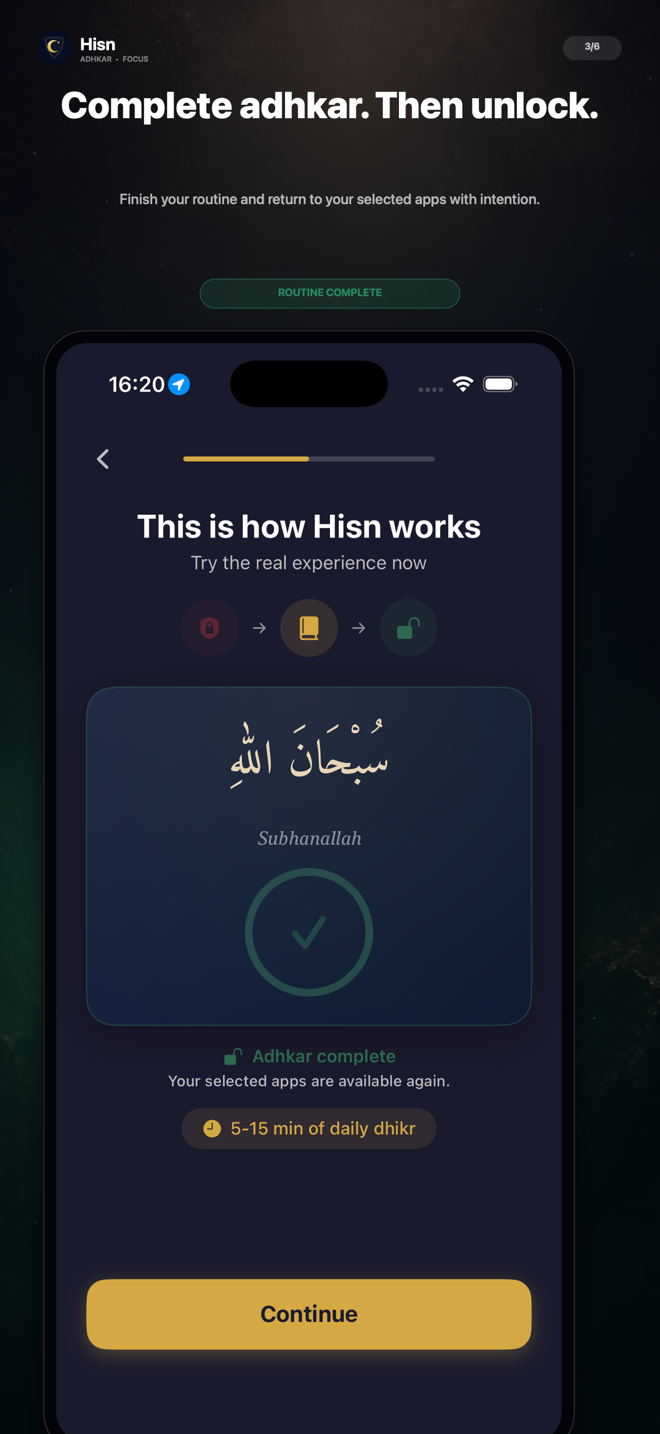
Hisn is an adhkar and focus app for iPhone and iPad. It organises a verified morning and evening adhkar flow. During a routine you configure, apps you selected can wait behind an Apple Screen Time focus shield; after completion, those selected apps become accessible again. Hisn does not lock the entire iPhone, and the user chooses which apps are included.
That design creates a deliberate boundary: selected apps wait while the configured routine is active. It does not make Hisn a religious authority, validate a person’s worship, guarantee consistency, or promise a particular spiritual, medical, or financial result. A reader who prefers a trusted printed collection can use the practical method in this article without Hisn.
CLEAR ANSWERS
Questions about the routine
Is dhikr limited to morning and evening?
The cited hadith supports continuing remembrance in general, while the cited verse contains morning-and-evening wording. This article does not define the full religious scope or timing of dhikr. Use a verified collection and seek qualified guidance for rulings.
Is a phone app necessary for a dhikr routine?
No. A traceable printed or digital collection and a reliable cue are enough to use the organisational method described here.
Does missing a personal cue invalidate the routine?
This article cannot decide that religious question. Do not invent a consequence from a missed reminder or broken streak; consult the guidance attached to your verified collection or a qualified scholar.
Does Hisn block the whole iPhone?
No. The focus shield applies to apps the user selects during the configured routine. Essential device access is not presented here as something that should be blocked.
Does completing a routine guarantee a result?
No. Hisn can organise a flow and create a boundary before selected distractions. It cannot measure sincerity, guarantee acceptance, or promise a religious or medical outcome.
This guide describes Hisn’s current iPhone and iPad focus flow without promising a guaranteed behavioral, medical, or religious outcome. Current App Store availability and device compatibility are shown by Apple.